Trust, Transparency & Impact
Discover how KSE upholds integrity, accountability, and strong governance to ensure every contribution creates meaningful and measurable impact.
Holistic Pathway to Sustainable Impact
We deliver long-term educational support by integrating financial assistance, character development, professional readiness, and social responsibility—empowering scholars to grow as capable, ethical, and impactful leaders.
Education Cost Support
Direct financial assistance for students' academic needs
Character Building & Leadership
Building integrity, national awareness, and leadership spirit
Network Strengthening & Work Readiness
Building professional connections and preparing for the transition to the workplace
Fostering Social Awareness
Encouraging students to become agents of change in society
Governance Principles & Leadership Model
Governance Philosophy
The Karya Salemba Empat Foundation views collective efforts to educate the nation as a key prerequisite for sustainable national development. Education is believed to be a long-term social investment that will produce superior human resources as strategic capital for the nation.
Salemba Empat Foundation is committed to ensuring that every individual has a fair opportunity to obtain an education. This commitment is realized through the implementation of formal education scholarship programs integrated with coaching for students facing financial constraints at state universities (PTN) throughout Indonesia.
“Good governance at KSE is built as a commitment to values that are consistently upheld, not merely as an administrative obligation.”
Governance Principles
Trust-based Governance
Public trust is managed through transparency, accountability, and openness of information.
Long-term Impact
Education is positioned as a social investment that provides sustainable impact.
Institutional Discipline
Systems, policies, and oversight mechanisms are implemented consistently and continuously over time.
Pro Bono Leadership & Stewardship
To date, all founders, members of the Board of Trustees, Supervisory Board, Executive Board, and Friends of KSE have performed their strategic roles on a pro bono basis, without receiving any remuneration. Furthermore, most of them also serve as active individual donors. Their contributions are not only in the form of financial support, but also include their time, expertise, knowledge, and professional networks.
“Leading by Giving, Governing with Heart. ”
Pro Bono Leadership & Stewardship Principles
Operational Professionalism
To ensure that the program is implemented effectively, efficiently, and sustainably, Yayasan Karya Salemba Empat is supported by a team of professional operational staff who work full-time and receive remuneration in accordance with applicable standards. A clear separation between the strategic role of pro bono administrators and the professional role of operational execution is part of the implementation of sound governance practices.
Supervision & Governance
KSE implements a governance structure with a clear separation of roles to maintain checks and balances, independence of oversight, and quality of decision-making.
Board of Trustees
Strategic oversight & policy direction
Supervisory Board
Independent oversight of management
Board of Directors
Strategic management & decision making
Operational Implementaion Team
Program execution & daily operations
Partnership Ecosystem at a Glance
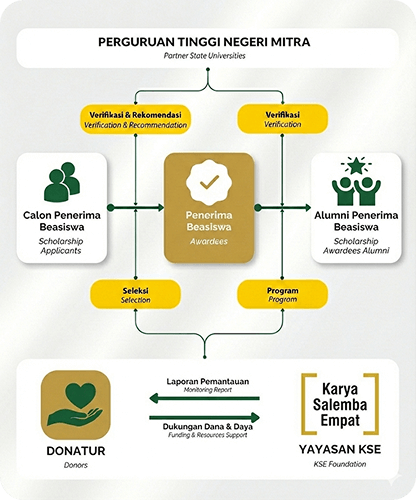
In carrying out the coaching program for students, cooperation with various parties is essential. The KSE Foundation works closely with donors, universities, and local stakeholders.
Our Funding Report
KSE funding comes from individual donors, corporations, and institutional partners. All funds are recorded, managed, and audited in accordance with applicable accounting standards and reported openly to the public.
IDR 670 bio
Cumulative total donations
since 1995
Since 2005
Independently audited by
registered public accountants
PwC (2024)
Audited by
PricewaterhouseCoopers
Strategic Investment
In addition to direct support for students, KSE makes strategic investments in capacity building programs, mentoring systems, and long-term collaborations that strengthen the quality of educational impact.
50%-80%
Living expenses or direct
academic needs allowances.
5%-40%
Training / Seminars / Soft skills,
and career preparation.
10%-15%
Monitoring, operations,
reporting, and sustainability.
Transparent & Accountable Process
Selection & Verification
Focus on identifying needs, selecting candidates, and verifying data objectively.
Implementation & Performance Tracking
Ensuring the distribution of funds, guidance, and continuous monitoring of achievements.
Reporting & Institutional Learning
Strengthening accountability through reporting, auditing, and continuous evaluation.
Strengthening Integrity Through Clear Policies
KSE has internal policies governing ethics, conflicts of interest, and legal compliance as guardians of organizational integrity.
Code of Ethics
Ethical guidelines for all foundation bodies
Conflict of Interest Policy
Prevention of conflicts of interest in decision-making
Governance & Compliance
Compliance with laws, regulations, and foundation provisions
Whistleblowing Mechanism
Internal reporting mechanisms to maintain integrity
Measuring Impact, Advancing Sustainable Development
Karya Salemba Empat (KSE) supporting SDG 4 (Quality Education), KSE provides scholarships to undergraduate students nationwide and equips them with essential soft skills and leadership training.
KSE also promotes SDG 5 (Gender Equality), with over 50% of recipients being female, empowering women to take active roles in leadership. Through its scholars and alumni, KSE further contributes to multiple SDGs, including poverty reduction, decent work, sustainability, and climate action.
Why Governance Matters
Public Trust
Building lasting confidence through transparency and accountability.
Organizational Sustainability
Ensuring long-term stability and responsible growth.
Long-Term Impact
Transforming every contribution into measurable, lasting educational outcomes across Indonesia.
General Governance Questions
Who can apply for or receive KSE programs/scholarships?
The KSE Program is intended for high-achieving students from underprivileged backgrounds who meet the required academic standards, demonstrate integrity, and show a strong commitment to personal development in accordance with the applicable provisions.
How does the selection process for scholarship recipients or programs work?
The selection process is conducted in multiple stages, including administrative verification, eligibility assessment, and evaluation of the beneficiaries’ commitment. The entire process is carried out based on the principles of objectivity and transparency.
Does KSE only provide financial assistance?
No. In addition to financial assistance, KSE also provides character development, leadership training, and capacity building through various structured programs.
Are beneficiaries required to participate in KSE activities?
Yes. Beneficiaries are expected to actively participate in mentoring programs and social activities as part of their personal development process and social contribution.
How does KSE ensure that donation funds are managed transparently?
KSE implements a financial reporting system that is independently audited and publishes its annual reports and financial statements openly to the public and donors.
Is KSE audited by an independent auditor?
Yes. KSE has been audited by a registered Public Accounting Firm since 2005. In 2024, the audit was conducted by PricewaterhouseCoopers (PwC).
Do KSE board members and management receive remuneration?
No. All members of the Supervisory Board, Advisory Board, Management, and Sahabat KSE serve in their roles on a pro bono basis. The daily operations are supported by professional staff who receive remuneration in accordance with applicable standards.
How can donors monitor the impact of their contributions?
Donors can access KSE’s Annual Report, impact reports, and program summaries. For strategic partners, KSE also provides customized reports tailored to specific collaboration needs.
Can donors direct their donations to specific themes or programs?
Yes. KSE offers opportunities for thematic funding, such as education, gender equality, disability inclusion, and environmental care, based on mutual agreement.
How can donors start a collaboration with KSE?
Donors and partners can contact the KSE team through official channels to discuss collaboration opportunities, funding schemes, and the most relevant forms of engagement.